Managing Director

Are you a business-minded and people-oriented executive director who can lead the CBG into a new phase of digitization, positioning, and organizational development? For the CBG|Center for Family History, we are looking for a visible leader who can set the course, bring people together, and convincingly convey the social value of family history.
CBG|Center for Family History
Everyone has the right to know where they come from. Guided by this conviction, the CBG|Center for Family History has been working since 1945 to make knowledge about family history accessible, to connect it, and to enrich it. The CBG is the place where genealogical knowledge, historical data, and personal stories come together. With its WieWasWie platform, it plays a central role in making family history sources digitally accessible. In addition, the CBG manages the National Register of Deceased Persons, serves as a leading genealogical knowledge organization, acts as an innovative partner in the field of data, and is the initiator of the Family History and Migration Research Network.
The CBG is a foundation with a supervisory board. Its financial position is sound. Its public duties are funded by a grant from the Ministry of Education, Culture, and Science, as well as fees, membership dues, and donations. For business services, such as heir searches and services for surviving relatives, a cost-recovery fee is charged.
The organization consists of 28 employees—including those on secondment from Den Haag Werkt—and 25 volunteers. They work in small teams: National Register of Deceased Persons Services, Operations, Collections, Service and Advisory, Research, and Public Outreach. The CBG has a committed and distinctive organizational culture, with a wealth of specialized knowledge and a flat organizational structure in which employees are accustomed to taking responsibility.
Developments, Context, and Challenges
In recent years, the CBG has evolved from a traditional knowledge organization into a central source of genealogical knowledge and historical data. By digitally unlocking, linking, and making data available, a solid foundation has been laid for a future-proof digital infrastructure for family history. In the coming years, the CBG will enter its next phase. The organization aims to further strengthen its leading position in the fields of genealogy and heritage and to ensure sustainable, secure, and independent access to genealogical data and digital heritage resources. Digitization, data quality, privacy, and digital autonomy play a key role in this effort.
Digital development touches the very core of the organization. It is not just about systems and websites, but also about service delivery, public outreach, and collaboration with partners. The CBG is working to modernize its digital services and develop methods to better reconstruct and link personal information from various sources. This creates new opportunities for research, public outreach, and international collaboration.
This phase calls for further professionalization. The CBG is small, substantively strong, and socially relevant, but it is also vulnerable if knowledge, processes, or responsibilities are concentrated too heavily in the hands of a few individuals. It is in the organization’s best interest to further strengthen its processes, improve management information, and strike a good balance between ambition and feasibility.
The financial landscape is also changing. The current revenue mix is healthy, but traditional revenue sources are under pressure. New products, services, and partnerships are needed to ensure the organization remains financially sound and relevant in the long term. The CBG’s public mission remains the guiding principle in this regard.
External positioning requires attention. The CBG operates in a field where public access, cost control, data stewardship, and collaboration with archival and knowledge partners are constantly evolving. Both nationally and internationally, there are opportunities to strengthen the CBG’s role as a knowledge organization, digital partner, and public actor.
Who are we looking for?
For the CBG, we are seeking an executive director with an academic level of work and thinking, final decision-making authority or management experience, and an affinity for family history, heritage, digitization, or public knowledge infrastructure. You do not need to come from the genealogy field, but you understand the value of family history and know how to connect it to societal developments related to identity, migration, digitization, and access to information.
You are a business-minded and people-oriented leader. You provide clarity, set priorities, and stay on course in an environment where substantive ambition, limited capacity, and changing external expectations converge. You have experience with organizational development and know how to carefully manage change within a small organization.
You have financial acumen and are able to analyze budgets, grant relationships, and investment issues. You don’t have to be a financial controller; as long as you’re capable enough to engage in discussions at the financial and business levels, make decisions, and effectively keep the supervisory board informed.
As a leader, you are visible, approachable, and clear. You give professionals the space they need, encourage them to take responsibility, and hold them accountable for commitments and results. You’re a good fit for a small organization with a wealth of specialized knowledge, and you understand that closeness, trust, and clear communication are key to successfully implementing change.
You have strong communication skills and are politically and administratively savvy. You can effectively interact with staff members, regulators, the ministry, archival partners, international contacts, and users. You speak and write Dutch fluently and are comfortable navigating English-speaking networks. Proficiency in another modern language is a plus.
You are a credible figurehead for the CBG. You navigate administrative and social networks with ease and know how to convincingly convey the value of family history. You are curious about digitization and recognize how data, public values, and new forms of service delivery can contribute to the future of the CBG.
An affinity for the broader social significance of family history is a plus. After all, family history touches on themes such as migration, identity, and shared history. An understanding of these different perspectives can help expand the CBG’s reach and relevance. In doing so, you are realistic, collaborative, and decisive. You are mindful of (cultural) diversity and the human dimension, and you are not afraid to provide direction when necessary.
What do you bring to the table?
In any case, you have:
- an academic level of work and thinking;
- experience in a leadership or management role, preferably in a knowledge-based organization, heritage institution, public organization, foundation, or hybrid public-private setting;
- experience with organizational development and facilitating change processes;
- an affinity for digitalization, data, public values, privacy, and digital services;
- financial and business acumen, including an understanding of grant and revenue models;
- experience with external positioning, network development, and stakeholder management;
- administrative acumen and experience working under the supervision of a supervisory board;
- A leadership style that allows for autonomy, encourages responsibility, and provides clarity.
What does the CBG offer?
The CBG offers a meaningful administrative position at an organization with a unique social mission. You’ll be working on a topic that is personally and socially relevant to many people: the question of where someone comes from and how family history can contribute to knowledge, identity, and connection.
You’ll be joining a small organization with deep subject matter expertise, dedicated employees, and a strong reputation both at home and abroad. The position offers a competitive salary in line with the company’s collective bargaining agreement.
Interested?
The CBG is being advised by Colourful People in this process. For more information, please contactHatice Türkmen, a partner at Colourful People, at06 46 08 12 32.
Are you interested? If so, please submit a cover letter and resume via the application form on the website.
More about this employer
Have a question? Get in touch
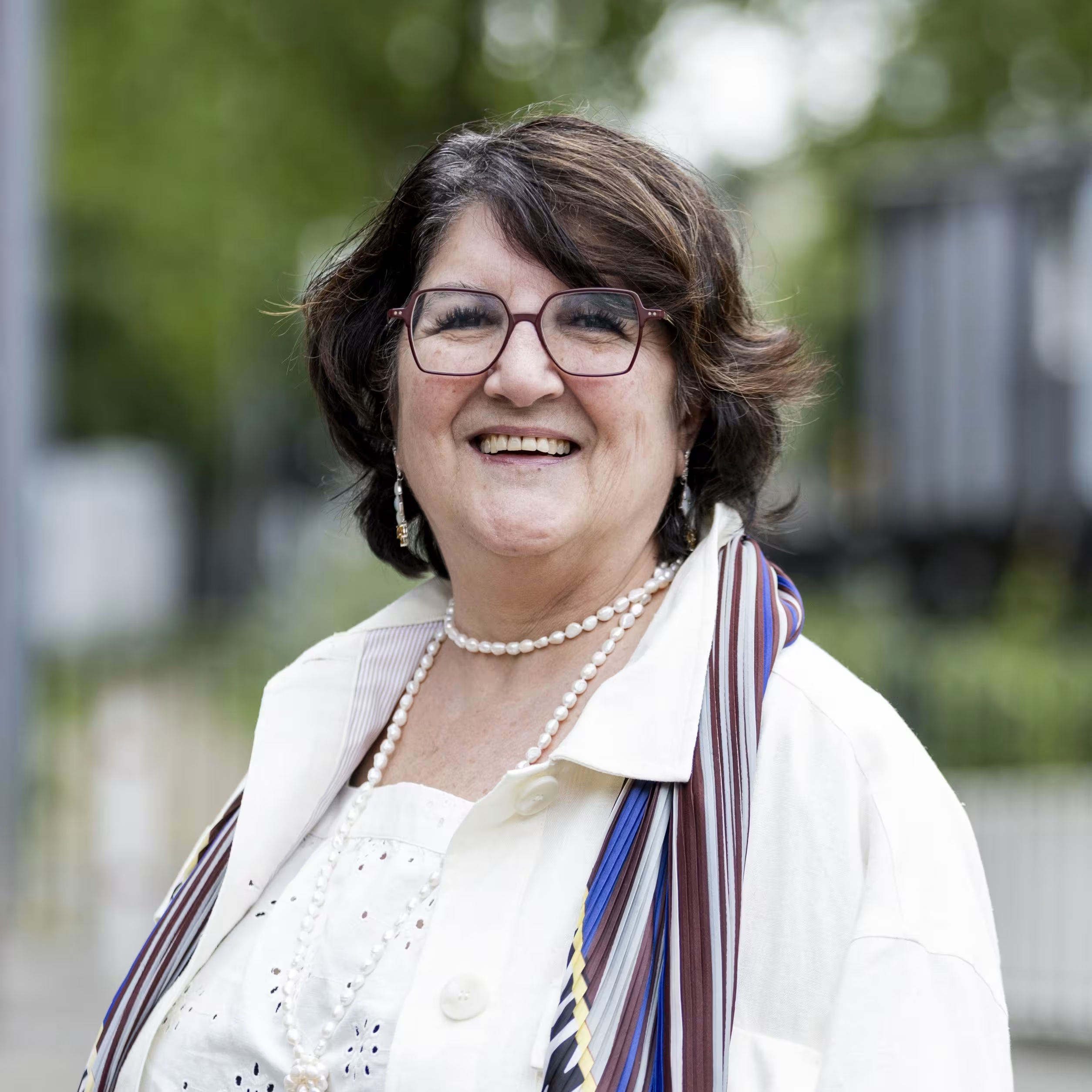
Hatice Türkmen
Partner at Colourful People